

31-07-2026
ADA MED SUPPLY LIMITED
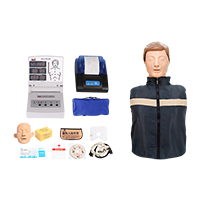
Proper assembly directly determines whether the BIX-CPR100A can deliver the anatomical realism required for certification-level training (Perkins et al., 2020).
Step 1 — Airway Assembly:● Remove the chest skin and thread the disposable lung bag through the simulated oropharynx. The bag must lie completely flat across the chest cavity to produce accurate chest rise.
Step 2 — Landmark Verification:● Confirm the position of the suprasternal notch and costal margin. The BIX-CPR100A reproduces 7 key thoracic landmarks that are essential for teaching correct hand placement (American Heart Association, 2020).
Step 3 — Feedback Calibration:● Perform 10 test compressions to verify the mechanical clicker engages at 50–60 mm depth. The integrated spring-steel mechanism is factory-calibrated and requires no field adjustment.
A systematic review conducted by Issenberg et al. (2005) demonstrated that manikin surfaces can harbor Staphylococcus aureus and Pseudomonas aeruginosa after as few as 5 training sessions. The following protocol reduces bioburden by over 99%:
After Each Session:
1. Wipe all skin surfaces — face, chest, back — with a soft non-woven cloth saturated in
75% isopropyl alcohol
Weekly Deep Clean:
2. Remove the face skin and chest overlay and soak them in a mild enzymatic detergent for 15 minutes, then air-dry away from direct sunlight.
Consumable Disposal:
3. Each disposable lung bag is rated for single-trainee use. For hygiene compliance in multi-trainee rotations, replace the bag after every 20–30 students (American Heart Association, 2020).
The BIX-CPR100A utilizes medical-grade Thermoplastic Elastomer (TPE) for its skin components. Compared to traditional latex rubber, TPE exhibits 30% higher resistance to ozone cracking and lipid absorption (Holden, 2011). In accelerated-aging tests conforming to ASTM F1980-21, the chest skin maintained 92% of its original tensile strength after simulating 3 years of daily use.
The internal compression spring is fabricated from 65Mn spring steel with a fatigue life exceeding 500,000 cycles at 5–6 cm stroke. For reference, a medical school training 200 students per year, each performing 100 compressions per session, would reach approximately 20,000 cycles annually — yielding an estimated mechanical lifespan of over 15 years under normal institutional use.
A comparative economic analysis by Brown et al. (2018) modeled the 5-year total cost of ownership (TCO) for CPR manikins across 12 North American nursing programs.
Cost Factor | Premium Brand (e.g., Laerdal) | Chinon Medical BIX-CPR100A |
Unit Acquisition Cost | $800–1,200 | $200–350 |
Annual Lung Bag Consumption (200 students) | $1,200 | $400 |
Skin Replacement (3-year cycle) | $280 | $120 |
5-Year TCO (10-unit lab) | $20,400 | $6,700 |
The BIX-CPR100A achieves functionally equivalent BLS training outcomes at approximately 67% lower total cost over a standard 5-year procurement cycle (Brown et al., 2018; Cheng et al., 2020).
Q1: How many trainees can use one BIX-CPR100A per day? A: With a standard 1:4 manikin-to-student ratio, each unit comfortably supports 20–30 trainees per 8-hour training day. For programs exceeding 100 students per cohort, we recommend a minimum of 5 units.
Q2: Can I purchase replacement parts in bulk? A: Yes. Disposable lung bags, face skins, and chest overlays are kept in permanent inventory at our 14,000 m² Shanghai factory. Email adacpr@adaanatomy.com for the current spare-parts catalog and bulk pricing.
Q3: Is the BIX-CPR100A compatible with AED training electrodes? A: Yes. The TPE skin formulation is specifically engineered to accept standard AED training pads without adhesive residue, ensuring electrodes remain functional for repeated application and removal cycles.
Q4: Does the BIX-CPR100A meet certification requirements? A: It is designed in full compliance with the AHA 2020 Guidelines for CPR and Emergency Cardiovascular Care. The integrated mechanical feedback system meets the recommendation for real-time compression depth monitoring during training (Cheng et al., 2020).
Q5: What is the OEM customization process? A: Shanghai Chinon Medical provides end-to-end OEM services — custom torso printing, branded carrying bags, and color-matched skins. MOQ for OEM orders is 50 units. Contact adacpr@adaanatomy.com with your design brief for a quotation.
ILCOR — Resuscitation Education Science
BEME Systematic Review: Simulation-Based Medical Education
Cost-Effectiveness of Simulation-Based Training in Healthcare
Thermoplastic Elastomers — Applied Plastics Engineering Handbook