

31-07-2026
ADA MED SUPPLY LIMITED
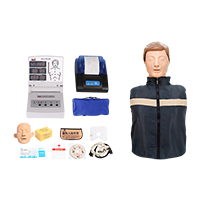
The BIX-CPR100A is a half-body electronic CPR training manikin designed for basic life support (BLS) education in schools, hospitals, and corporate training centers. It features a tri-color LED feedback system that monitors compression depth and frequency in real time — an essential feature the AHA 2025 Guidelines now emphasize as a standard for effective CPR instruction. The manikin is molded from thermoplastic elastomer (TPE) for realistic tactile response, supports 30:2 compression-to-ventilation cycles, and includes carotid pulse simulation for comprehensive scenario training.
Specification | Detail |
Model | BIX-CPR100A |
Type | Half-body, electronic CPR training manikin |
Material | Thermoplastic elastomer (TPE), injection molded |
Feedback | Tri-color LED (yellow/green/red for depth & rate) |
Compression Rate Detection | 0–60 / 60–80 / 80–100 / 100–120 beats/min (4-tier LED) |
Compression Depth Zones | <5cm (yellow), 5–6cm (green), >6cm (red) |
Ventilation Feedback | Dynamic LED for inhalation volume (500–1000ml) |
Carotid Pulse | Simulated spontaneous pulse |
Standard Compliance | AHA 2025 CPR & ECC Guidelines |
Cycle Ratio | 30:2 (compression : ventilation) |
The American Heart Association's 2025 Adult Basic Life Support Guidelines reaffirm that high-quality CPR is the single most important intervention linked to improved cardiac arrest outcomes. The defining metrics are:
Compression depth:
● 5–6 cm (2–2.4 inches)
Compression rate:
● 100–120 compressions per minute
Chest compression fraction (CCF):
● >80%
Full chest recoil
● between compressions
A 2023 meta-analysis published in the Journal of the American Heart Association found that real-time feedback devices produced a "moderate to large effect" on all CPR quality parameters during training [1]. The AHA 2025 Guidelines further note that "CPR feedback devices had a moderate to large effect on all CPR quality outcomes" — a Class 2a recommendation (Level of Evidence B-R) [2].
The logic is straightforward: trainees cannot see inside the chest. Without electronic feedback, a student performing compressions at 4.2 cm depth feels identical to 5.2 cm. The BIX-CPR100A's tri-color LED system closes this gap by providing immediate, unambiguous visual correction:
Light Color | Compression Depth | Compression Rate |
Yellow | <5 cm (too shallow) | <60 bpm (too slow) |
Green (single) | 5–6 cm (correct) | 60–80 bpm |
Green (double) | 5–6 cm (correct) | 100–120 bpm (ideal) |