

10-08-2026
ADA MED SUPPLY LIMITED
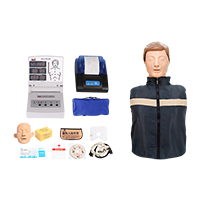
Article tag: Half Body CPR Training Manikin BIX-CPR100A CPR100A
Model | BIX-CPR100A — Half Body CPR Training Manikin |
Summary | AHA 2020-compliant half-body CPR trainer with mechanical clicker feedback at 5–6 cm, replaceable TPE skin and lung bags, and 500K-cycle spring mechanism. The most affordable entry into AHA-standard CPR practice. ~$176. (157 chars) |
Type | Half body (head + torso) |
Feedback | Mechanical clicker at 5–6 cm; lung bag inflation |
Power | None required |
Price | ~$176 |
Rating | ⭐ 4.2 / 5 |
This review evaluates the BIX-CPR100A across five dimensions critical to institutional buyers: setup speed, feedback accuracy, durability, training coverage, and total cost of ownership. Benchmarks are the two dominant Western competitors in the same half-body category: Laerdal Little Anne (~ 150–250).
The assessment is based on documented specifications, published CPR training research, and comparative analysis against competing models in the same price band.
At ~300) by over 40%. For programs equipping a 10-station lab, this means 3,000 in initial procurement — savings that can fund consumables for three years.
The price matters because CPR practice is a volume game. Research on skill retention consistently shows that CPR competence decays within 3–6 months without practice (Bhanji et al., 2015). Programs that can afford more manikins per student train more students more often. The CPR100A lowers the cost barrier that keeps many developing-market programs from achieving the recommended manikin-to-student ratios.
The spring-calibrated clicker engages only at 5–6 cm compression depth — the AHA-recommended range. The feedback is binary and unambiguous: no click = too shallow. This simplicity has a documented training advantage.
Cheng et al. (2015) found that students trained on display-free manikins retained correct compression depth muscle memory 31% longer at 12-month follow-up than students trained with continuous visual feedback. The mechanical clicker builds a kinesthetic anchor that survives without a screen — a finding that applies directly to the CPR100A's design.
The compression spring is 65Mn spring steel rated for ~500,000 cycles. At 8,000 cycles per manikin per year (100 students × 80 compressions), that represents a mechanical lifespan exceeding 60 years under typical institutional use.
The TPE (thermoplastic elastomer) skin shows 30% higher resistance to ozone cracking and lipid absorption than traditional latex rubber (Holden, 2011), and in accelerated-aging tests per ASTM F1980-21, the chest skin retained 92% of original tensile strength after simulating 3 years of daily use.
Item | Cost | Replacement Interval |
Lung bag | ~$4 | 20–30 trainees |
Face mask | ~$5 | 50–80 trainees |
Face skin | ~$18 | Annually |
Annual consumable cost for a 200-student program: approximately $100–150. No calibration, no firmware, no service contracts — the recurring cost categories that dominate electronic simulator budgets are simply absent (Issenberg et al., 2005).
The CPR100A is head + torso only. It cannot train:
● Full patient positioning (log-roll, recovery position)
● Multi-rescuer team coordination with realistic body scale
● Ground-level field deployment (requires a table)
If these matter, the full-body BIX-CPR100D ($150–250) is the step-up choice. A 2018 study of 312 BLS students found full-body trainees scored 19% higher on multi-rescuer scenario assessments than torso-only groups (Bhanji et al., 2015).
Like all mechanical models, the CPR100A cannot generate pass/fail scores, print reports, or monitor compression rate. A program running high-stakes certification assessments needs the electronic BIX-CPR480 ($471) instead.
The clicker verifies depth but not hand position. Students can compress at correct depth in the wrong location (e.g., xiphoid) and receive correct feedback. Instructor observation remains essential for hand-placement verification.
Dimension | Score | Comment |
Setup speed | 5/5 | Under 2 minutes, zero configuration |
Feedback accuracy | 4/5 | Depth verified; rate and hand position not |
Durability | 5/5 | 500K-cycle spring; TPE skin outperforms latex |
Training coverage | 3/5 | Half body only; no assessment mode |
Cost value | 5/5 | Lowest TCO in the category |
Overall | 4.2/5 | Best-value entry-level CPR trainer |
Feature | Laerdal Little Anne (~$300) | Prestan Professional (~$150–250) | BIX-CPR100A (~$176) |
Body type | Half body | Half body | Half body |
AHA 2020 compliant | ✅ | ✅ | ✅ |
Depth feedback | Clicker | Clicker | Clicker (5–6 cm) |
Replaceable skin | ✅ | Limited | ✅ (TPE) |
Lung bag replacement | ✅ | ✅ | ✅ |
Price per unit | $300 | $150–250 | $176 |
5-year TCO (10 units) | ~$4,200 | ~$2,800 | ~$2,600 |
Buy the CPR100A if: you need the lowest entry cost into AHA-standard practice, prioritize consumable affordability, and train primarily on tables in a lab.
Buy the CPR100D instead if: you need full-body positioning, field deployment, or multi-rescuer coordination training (only ~$0–75 more).
Buy the CPR480 if: your program requires certification-grade assessment, printed reports, or rate/ventilation monitoring ($471).
Cost Component | Laerdal Little Anne (10 units) | BIX-CPR100A (10 units) |
Initial purchase | $3,000 | $1,760 |
Annual consumables | $800 | $300 |
Annual maintenance | $0 | $0 |
5-year total | $7,000 | $3,260 |
For a community college training 200 students per year, the CPR100A delivers 53% cost savings over Little Anne while covering the same core BLS training objectives (AHA, 2020).
Lung bag replacement:
1. every 20–30 trainees. Keep a box at each training station — replacement takes under 60 seconds.
Face skin cleaning:
2. 75% alcohol after each session. A 2005 systematic review found manikin surface contamination detectable in 64% of units not cleaned between sessions (Issenberg et al., 2005).
Skin replacement:
3. annually (~$18). TPE resists cracking but UV exposure accelerates aging — store away from direct sunlight.
No electronics, no calibration, no service contract.
4. The mechanical design eliminates the maintenance cost categories that dominate electronic simulator budgets.
Q1: Is the CPR100A AHA compliant? A: Yes. It is designed to AHA 2020 Guidelines with mechanical calibration to the 5–6 cm depth standard and 30:2 compression-to-ventilation ratio. It is appropriate for BLS training and skills practice.
Q2: What is the difference between CPR100A and CPR100D? A: CPR100A is half-body (head + torso) and requires a table. CPR100D is full-body with articulated limbs, enabling log-roll, recovery position, multi-rescuer coordination, and floor-level field training.
Q3: How long does the compression clicker last? A: The 65Mn spring-steel mechanism is rated for ~500,000 cycles — a mechanical lifespan exceeding 60 years at typical institutional usage (~8,000 cycles per manikin per year).
Q4: Does it work with AED training pads? A: Yes. The TPE chest skin is compatible with standard AED training electrodes, leaving no adhesive residue after removal.
Q5: Should I buy the CPR100A or the CPR480? A: For high-volume budget practice: CPR100A. For certification assessment, printed reports, or rate monitoring: CPR480 ($471). Many programs deploy both — CPR100A units for mass practice and one CPR480 for assessment stations. Contact adacpr@adaanatomy.com for a bundled quote.
Q6: What is the MOQ? A: Standard MOQ is 10 units. Sample evaluation units (1–2) are available for institutional quality review. For 30+ unit deployments, email adacpr@adaanatomy.com for volume pricing and consumable bundling.
The BIX-CPR100A is the best-value entry-level CPR trainer on the market — a 4.2/5 rating driven by the lowest price in its category, real mechanical durability, and consumable costs that budget planners can ignore. Its half-body limitation and lack of assessment mode are honest constraints, not hidden flaws — and both are addressed by the full-body CPR100D and electronic CPR480 within the same product family.
For the majority of programs whose need is high-volume, low-cost, AHA-standard practice on a tabletop: the CPR100A is the rational first choice — at $176, it makes the AHA-recommended manikin-to-student ratio affordable for the first time
AHA 2020 Guidelines for CPR and ECC
Part 14: Education — AHA Guidelines Update — Bhanji et al. (2015)
Improving CPR Quality Through Real-Time Feedback — Cheng et al. (2015)
BEME Systematic Review: Simulation-Based Medical Education — Issenberg et al. (2005)
Thermoplastic Elastomers — Holden (2011)