

19-08-2026
ADA MED SUPPLY LIMITED
Article tag: CPR simulation CPR training manikin what is CPR simulation
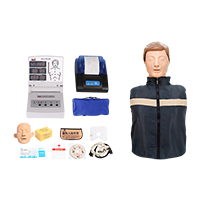
Product Line | BIX CPR Simulation Manikins (CPR100A / CPR100D / CPR480 / CPR160A / CPR170 / ACLS150) |
Summary | AHA-compliant CPR simulators across all fidelity levels: mechanical clicker models (471), newborn 3:1 trainer (1,472.90), and seven-module neonatal system. For every age group and budget. (157 chars) |
Fidelity Range | Mechanical → Electronic → Comprehensive systems |
Age Coverage | Adult, pediatric, neonatal |
Feedback | Depth, rate, ventilation, position |
Application | BLS/PALS/NRP training, certification, OSCE |
CPR simulation is the practice of cardiopulmonary resuscitation on a training manikin — an anatomically representative model of a human — rather than on a person. It serves three purposes that clinical practice cannot:
Skill acquisition:
1. Repetition of compression technique, airway management, and ventilation without risk to a patient.
Objective assessment:
2. Electronic manikins measure compression depth, rate, ventilation volume, and hand position — converting subjective practice into measurable performance data.
Scenario training:
3. Simulators enable full cardiac arrest scenarios — including AED use and team coordination — that cannot be rehearsed on real patients.
The core principle was established by the BEME systematic review by Issenberg et al. (2005): simulation-based medical education is effective when it provides feedback, repetitive practice, and curriculum integration — the three features a CPR manikin with feedback is built to deliver.
The evidence that CPR providers perform poorly is sobering — and it is the strongest argument for simulation training.
A multicenter study of 1,200 BLS-certified healthcare providers found that only 28% performed chest compressions within the recommended 5–6 cm depth range. Critically, 83% believed their compression depth was adequate (Abella et al., 2005).
This is the perception-performance gap: providers think they are doing CPR correctly when they are not. A mechanical manikin's clicker (audible at correct depth) and an electronic manikin's real-time display close this gap by making quality visible. Simulation turns "I think I'm compressing deep enough" into "I can see I'm not."
A randomized trial by Kramer-Johansen et al. (2006) quantified the improvement: students trained with electronic feedback achieved correct compression depth 47% more often during initial training, and retained 31% higher correct-compression rates at 6-month retest — the retention advantage of feedback-based simulation.
CPR simulators range across a fidelity spectrum — higher fidelity means more realistic feedback, but also higher cost.
Fidelity Level | Example | Feedback | Typical Price | Best For |
Basic mechanical | Half-body manikin with clicker | Audible click at correct depth | $100–250 | Mass training, budget programs |
Full-body mechanical | Full-body manikin, articulated limbs | Clicker + lung bag inflation | $150–300 | Positioning + team training |
Electronic feedback | Manikin with sensors + display | Depth, rate, ventilation, assessment mode | $400–800 | Certification, objective scoring |
Comprehensive system | Multi-module (airway, ECG, defib, auscultation) | Full physiological simulation | $2,000+ | NRP/PALS programs, regional hubs |
The cost-effectiveness insight: research shows skill acquisition differences between mechanical and electronic training are modest in the short term — but retention favors feedback training (Cheng et al., 2015). A common institutional pattern is mechanical manikins for mass practice + one electronic model for assessment.
CPR technique differs fundamentally across age groups — and simulation must match:
Age Group | Ratio | Depth | Simulator Requirement |
Adult | 30:2 | 5–6 cm | Standard adult manikin |
Child | 30:2 / 15:2 | One-third AP (~5 cm) | Pediatric manikin with dual-ratio support |
Infant | 30:2 / 15:2 | One-third AP (~4 cm) | Infant manikin, two-finger technique |
Neonate | 3:1 | One-third AP | Newborn manikin enforcing 3:1 |
Training on an adult manikin cannot teach neonatal 3:1 resuscitation — the ratio differs by a factor of ten, and muscle memory from adult training actively interferes with neonatal performance (Wyckoff et al., 2015). Age-appropriate simulators are not a luxury; they are a safety requirement.
Based on the evidence for effective simulation (Issenberg et al., 2005; Bhanji et al., 2015), a complete program includes:
Manikins with feedback
1. — mechanical clicker for mass practice, electronic model for assessment.
Age-appropriate models
2. — adult, pediatric, and neonatal units.
AED trainer
3. — for combined compression + defibrillation scenarios.
Scheduled skill refresh
4. — every 3–6 months, matching documented skill decay.
Objective assessment protocol
5. — pass/fail thresholds recorded per student.
Chinon Medical manufactures the full spectrum — from the $176 adult mechanical model to the seven-module neonatal system — with consumables available for all models. For program design consultation and institutional quotes: adacpr@adaanatomy.com..
Q1: How much does a CPR simulator cost? A: From ~500 for an electronic feedback model with assessment mode, and $2,000+ for comprehensive multi-module systems. Most programs start with mechanical units for mass practice plus one electronic model for assessment.
Q2: Is electronic feedback worth the higher cost? A: Research shows feedback training improves correct compression depth by 47% and retention by 31% at 6 months (Kramer-Johansen et al., 2006). For certification programs requiring objective assessment, electronic feedback is essential; for mass practice, mechanical clicker models deliver most of the benefit at lower cost.
Q3: How many manikins does a program need? A: The AHA recommends a 1:4–1:5 manikin-to-student ratio. A 40-student class needs 8–10 units. At $176 per mechanical unit, the recommended ratio is achievable on community college budgets.
Q4: Can I train adult and neonatal CPR on the same manikin? A: No — and this is critical. The ratios (30:2 vs 3:1), depth, and techniques differ fundamentally. Neonatal training requires a dedicated newborn manikin; adult muscle memory actively interferes with neonatal performance.
Q5: How often should manikins be replaced? A: Mechanical manikins last 20+ years (springs rated for ~500,000 cycles); skins last 5–7 years; lung bags are consumables replaced every 20–30 trainees. Electronic models require sensor recalibration every 2–3 years.
Q6: Does simulation training count toward certification? A: Yes. AHA BLS certification includes a skills assessment performed on a training manikin. Electronic models with assessment mode provide objective pass/fail records. For equipment and consumables: adacpr@adaanatomy.com..