

28-08-2026
ADA MED SUPPLY LIMITED
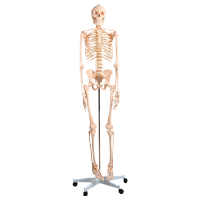
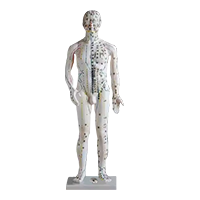
Article tag: 180cm Human skeleton model BIX-A1001 A1001
Product Line | BIX skeleton models (full-size, half-size, extremity) |
Summary | BIX skeleton models for anatomy study — full-size, half-size, and extremity models with landmarks and articulation. For classrooms and labs. (139 chars) |
Key Models | A1002 full skeleton, A1004 half-size, A1031 upper limb, A1032 lower limb |
Applications | Medical schools, nursing programs, PT/OT programs, labs |
Price | On request |
Yes — but the value depends on how you use them. Skeleton models earn their place in anatomy education for three evidence-backed reasons:
Touch matters.
1. Anatomy is spatial, and touch is the fastest channel for understanding 3D relationships. Physical models deliver tactile feedback that screens cannot.
Rotation builds mental models.
2. Physically rotating a model trains spatial reasoning — the cognitive skill anatomy exams actually test (Garg et al., 2002).
Repeatability beats rarity.
3. Cadavers and dissection are limited resources; a model can be picked up, quizzed on, and rotated a hundred times without cost or ethical constraint.
Dimension | Textbook / Atlas | 3D App | Cadaver | Skeleton Model |
Cost per student | Low | Low | Very high | Moderate (one-time) |
Tactile feedback | ✗ | ✗ | ✓ | ✓ |
Repeatable practice | ✓ | ✓ | ✗ | ✓✓ |
Landmark palpation | ✗ | ✗ | ✓ | ✓ |
Spatial rotation | Limited | ✓ | ✓ | ✓✓ |
Accessibility | ✓ | ✓ | Limited | ✓✓ |
Maintenance | — | — | High | Low |
The verdict: no single tool wins every row. The evidence supports a blended approach — and the physical model is the only low-cost tool that scores ✓ on touch, rotation, and repeatability at the same time.
A direct comparison of a physical model, a 3D computer model, and a textbook for learning imaging anatomy found that students using the physical model achieved significantly better test scores — authors concluded that physical models "appear to offer a distinct advantage" for understanding spatial anatomy (Preece et al., 2013).
A meta-analysis of 3D visualization technologies in anatomy education found overall positive effects on factual and spatial knowledge, yet the authors caution that the biggest gains appear when 3D tools are combined with traditional physical resources rather than replacing them (Yammine & Violato, 2015). A second meta-analysis reached a similar conclusion: mixed-resource approaches outperform any single medium (Khot et al., 2013).
A systematic review of dissection as a teaching method confirmed the unique value of cadavers for humanistic and clinical learning, but also documented the practical barriers of cost, availability, and staffing (Winkelmann, 2007). Skeleton models scale where cadavers cannot: every student, every lab session, every day.
Classic spatial-cognition research in anatomy education found that learners benefit most from actively viewing structures from multiple orientations — exactly what a handheld model provides and a single textbook figure cannot (Garg et al., 2002).
Strategy | Why It Works | Evidence Link |
Active rotation before recall | Rotate and name bones/landmarks from every angle; testing yourself beats re-reading | Garg et al., 2002 |
Touch-and-name loops | Point to a landmark, say its name, then check with the numbered key | Preece et al., 2013 |
Pair with an atlas | Use the atlas for detail, the model for 3D context — not one or the other | Khot et al., 2013 |
Spaced quizzing | Quiz yourself at 1 day, 3 days, 1 week; physical models make quizzing fast | Yammine & Violato, 2015 |
Palpation practice | For clinical programs, practice locating landmarks on the model before patients | Winkelmann, 2007 |
Learning Level | Recommended Type | BIX Example |
Beginner / general anatomy | Half-size with color-coded structures | A1004 |
Clinical / palpation training | Full-size 1:1 scale | A1002 |
Upper limb focus | Life-size extremity with articulation | A1031 |
Lower limb focus | Life-size extremity with articulation | A1032 |
Quick review / patient education | Compact desktop model | L013 |
Q1: Are skeleton models as good as cadavers for learning anatomy? A: No single resource fully replaces dissection — cadavers offer unmatched realism and humanistic learning (Winkelmann, 2007). But skeleton models are the evidence-supported, scalable partner: they provide repeatable tactile and spatial practice that cadavers cannot offer at scale.
Q2: Is a physical model better than a 3D anatomy app? A: For imaging anatomy, students using a physical model scored significantly higher than those using a 3D computer model or textbook (Preece et al., 2013). Meta-analyses show the best outcomes come from combining digital and physical resources (Yammine & Violato, 2015).
Q3: What size skeleton should a medical school buy? A: A 1:1 full-size model for palpation and clinical skills, plus half-size models for group teaching and labs. BIX offers both — see Section 5.
Q4: Can a skeleton model help with exam preparation? A: Yes. Active rotation and self-testing with a physical model train the spatial reasoning that anatomy exams measure (Garg et al., 2002) — and you can quiz yourself repeatedly without cost.
Q5: How durable are BIX skeleton models? A: They are made of high-quality PVC with metal joints for articulation. Request the warranty period and replacement-parts policy from your supplier at adacpr@adaanatomy.com
Q6: What is the MOQ and delivery time? A: MOQ is 1 unit. Air freight: 7–10 business days; sea freight for larger orders: 30–45 days. Email adacpr@adaanatomy.com for a quote to your destination.
Let's Get Physical: Advantages of a Physical Model over 3D Computer Models and Textbooks in Learning Imaging Anatomy — Preece et al. (2013), Anat Sci Educ 6(4):216–224
A Meta-Analysis of the Educational Effectiveness of Three-Dimensional Visualization Technologies in Teaching Anatomy — Yammine & Violato (2015), Anat Sci Educ 8(6):525–538
The Relative Effectiveness of Computer-Based and Traditional Resources for Education in Anatomy: A Systematic Review and Meta-Analysis — Khot et al. (2013), Anat Sci Educ 6(4):211–219
Anatomical Dissection as a Teaching Method in Medical School: A Review of the Evidence — Winkelmann (2007), Med Educ 41(1):15–22
Is There Any Real Virtue of Virtual Reality? The Minor Role of Multiple Orientations in Learning Anatomy from Computers — Garg et al. (2002), Acad Med 77(10 Suppl):S97–S99