

08-09-2026
ADA MED SUPPLY LIMITED
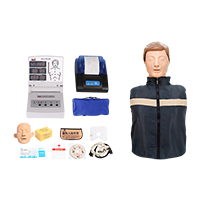
Article tag: Full Body CPR Manikin with LCD Feedback BIX/CPR480 CPR480
Model | BIX/CPR480 — Full Body CPR Manikin with LCD Feedback |
Summary | Full-body electronic CPR manikin with LCD and three-color feedback on depth, rate and ventilation, counters, exam modes, carotid pulse and pupil exam. (150 chars) |
Type | Full-body, fully automatic electronic CPR training manikin (adult) |
Feedback Channels | Compression depth (green 5–6 cm / yellow <5 cm / red >6 cm) · rate counter · ventilation volume (500/600–1,000 ml, three-color) |
Display | LCD + digital correct/wrong counters + voice prompts (volume on/off) |
Modes | Exercise · Exam · Custom-defined; 30:2 compression-to-ventilation ratio (one or two rescuers) |
Assessment Output | Detachable printer prints operation results |
Patient Signs | Palpable carotid pulse (simulated spontaneous pulse during and after compressions) · pupil-response exam (mydriasis/miosis) |
Material | Thermoplastic elastomer (TPE) face skin, neck/chest skin, hair — high-temperature injection molding |
Price | USD 471 (FOB, reference) |
Compliance | Calibrated to AHA 2020 targets: depth 5–6 cm, rate 100–120/min, ventilation 500–1,000 ml |
Audience | BLS/CPR certification centers, nursing schools, EMT/EMS academies, hospital training departments, first-aid course providers |
Educational-use note: CPR training manikin — educational equipment for skills training; not a medical device or a pharmaceutical product and contains no medicinal ingredients (manufacturer's product-page notice). Configuration details (power adapter, consumables, language options for voice prompts) should be confirmed against the specification sheet before ordering.
The evidence that CPR skill quality is inadequate — even among certified providers — is the strongest reason to move from practice-only manikins to objective electronic assessment:
Real arrests show poor technique.
● In a landmark study of in-hospital cardiac arrest, chest compressions were frequently performed too shallow and too slow relative to guideline recommendations, even by hospital staff (Abella et al., 2005).
Feedback fixes it in the field.
● A prospective interventional study of out-of-hospital cardiac arrest found that real-time automated feedback significantly improved the quality of CPR delivered by EMS crews (Kramer-Johansen et al., 2006).
Depth drives survival.
● In out-of-hospital cardiac arrest, patients receiving deeper compressions consistent with the 2010+ AHA recommendation of ≥5 cm had better survival to hospital discharge than those receiving shallower compressions (Vadeboncoeur et al., 2014).
Quality is a survival determinant.
● Compression depth (5–6 cm), rate (100–120/min), full recoil, and minimal interruptions are the core quality metrics that determine CPR effectiveness (Meaney et al., 2013; Panchal et al., 2020).
A manikin that only clicks at 5 cm cannot tell a student — or an instructor — whether rate, recoil, or ventilation volume were correct. The CPR480 turns every practice session into objective, measurable data, which is exactly what certification-grade assessment requires.
Evidence | Finding | Training Implication |
Abella et al., 2005 (JAMA) | Compressions during real in-hospital arrests frequently fell below guideline depth/rate | Trainees cannot rely on feel — objective feedback is needed |
Kramer-Johansen et al., 2006 (Resuscitation) | Real-time automated feedback improved delivered CPR quality in OHCA (prospective interventional) | Feedback devices measurably improve real performance |
Vadeboncoeur et al., 2014 (Resuscitation) | Deeper compressions (≥5 cm) associated with better survival after OHCA | Training must enforce the 5–6 cm depth zone |
Meaney et al., 2013 (Circulation) | Depth, rate, recoil, interruption are the measurable quality metrics | Assessment devices should track all key metrics |
Gilfoyle et al., 2023 (JAHA) | Real-time feedback use associated with higher-quality compressions delivered by EMS personnel | Feedback training transfers to operational practice |
Panchal et al., 2020 (AHA 2020 Guidelines) | High-quality CPR is the strongest determinant of survival in cardiac arrest | Certification programs should assess, not just practice |
Skill | Detection | Feedback |
Compression depth | Standard airway opening simulated; hand-position chest compressions | Dynamic three-color indicator: green in the 5–6 cm zone; yellow below 5 cm; red above 6 cm |
Compression/ventilation count | Correct and incorrect operations counted | Digital counter display + voice prompt explaining errors |
Compression rate | Operation frequency per international standard | Instructor-visible rate target: 100–120/min (AHA 2020) |
Ventilation volume | Inhalation from 500/600 ml to 1,000 ml measured | Three-color light per volume; correct range green, out-of-range red/yellow; counter + voice prompt |
Ratio & cycles | 30:2 compression-to-ventilation ratio, one or two rescuers; one cycle = five 30:2 rounds | Programmed assessment logic |
Pupil response | Pupil examination: mydriasis and miosis | Anatomical training signal for patient-status assessment |
Carotid pulse | Manual carotid palpation; simulated spontaneous pulse during and after compressions | Reinforces pulse-check steps in the BLS sequence |
Exercise mode
● — real-time guidance for skill acquisition.
Exam mode
● — objective assessment; performance recorded for review.
Custom-defined mode
● — instructor-set parameters for scenario-specific drills.
Detachable printer
● — prints operation results for documentation, audits, and certification records.
Model | Body | Feedback Type | Distinctive Feature | Price (reference) |
CPR100A | Half | Mechanical click | Basic electronic counters | USD 176.74 |
CPR100D | Full | Mechanical click | Best-value full-body practice | USD 150–250 |
CPR260 | Half | Electronic | Built-in printer (half-body) | On request |
CPR280 | Full | Electronic LCD | Pulse + pupil + voice prompts (teaching) | USD 441.88 |
CPR480 | Full | Electronic LCD | Assessment-grade three-channel scoring + carotid/pupil + detachable printer | USD 471 |
CPR490 | Full | Electronic | Flagship: printed reports + defibrillation training | On request |
Buying logic: practice-density purchases go to CPR100A/CPR100D; teaching scenarios with pulse/pupil demonstration can use CPR280; assessment and certification stations are the CPR480's role — one unit per exam station, paired with lower-cost units for practice rotations. Programs needing full printed-report workflows plus defibrillation drills step up to the CPR490.
1. Instructor demonstrates the 30:2 sequence; student practices with real-time green/yellow/red guidance.
2. Voice prompts explain each error as it occurs.
3. Rotate so every student completes ≥2 full five-cycle rounds.
1. Student locates carotid pulse on the manikin during and after compressions.
2. Pupil-response exam: compare mydriasis/miosis states before and after procedures.
3. Practice the pulse-check step timing (≤10 s) per AHA sequence.
1. Run exam mode; instructor observes counters and three-color indicators.
2. Print the operation result for the student record/audit file.
3. Custom mode for scenario re-testing.
● Schedule 6-month refreshers: CPR skill decay without practice is well documented, so assessment stations earn their cost through re-certification cycles (Panchal et al., 2020).
Item | Frequency | Notes |
Face skin / neck-chest skin | Replace as needed | TPE, hygienic rotation between groups |
Lung bag | Per syllabus | Replaceable consumable |
Sensor calibration | Factory-rated; annual recalibration recommended for high-stakes exams | Contact manufacturer |
Voice prompt volume | Per session | Adjustable; can be muted |
Storage | Always | Keep electronics dry; avoid immersion |
Q1: Can the CPR480 produce printed performance records? A: Yes — the CPR480 includes a detachable printer that prints operation results, giving instructors and certification bodies paper documentation of each student's performance. (This differs from the half-body CPR260, which is the printer variant for compact programs.)
Q2: Is the CPR480 compliant with current AHA guidelines? A: It is calibrated to AHA 2020 targets: depth 5–6 cm, rate 100–120/min, ventilation 500–1,000 ml, with 30:2 ratio programming. It detects and displays all three parameters required for BLS skills assessment. Confirm the calibration certificate and language options with the specification sheet.
Q3: What is the difference between the CPR480 and the CPR280? A: CPR280 (USD 441.88) is a full-body electronic manikin emphasizing pulse/pupil demonstration and voice-prompted teaching. The CPR480 adds the assessment-grade package — three-channel objective scoring plus a detachable printer for exam records — which is why it is the certification-station recommendation.
Q4: What is the difference between the CPR480 and the CPR490? A: The CPR490 is the family flagship, adding defibrillation training to the printed-report workflow. If your curriculum must combine CPR assessment with AED/defibrillation drills in one device, choose the CPR490; otherwise the CPR480 covers BLS skills assessment at lower cost.
Q5: What is the MOQ and are evaluation units available? A: Standard MOQ is 5 units; single evaluation units are available for institutional review. For certification centers deploying 10+ stations with a mix of CPR480 (assessment) and CPR100A/CPR100D (practice), email adacpr@adaanatomy.com for a bundled procurement proposal.
Q6: What is the price and delivery time? A: Reference price is USD 471 per unit. Air freight: 7–10 business days; sea freight: 30–45 days. Email adacpr@adaanatomy.com for the quotation and specification sheet.
Quality of Cardiopulmonary Resuscitation During In-Hospital Cardiac Arrest — Abella et al. (2005), JAMA 293(3):305–310
Quality of Out-of-Hospital Cardiopulmonary Resuscitation with Real Time Automated Feedback: A Prospective Interventional Study — Kramer-Johansen et al. (2006), Resuscitation 71(3):283–292
Chest Compression Depth and Survival in Out-of-Hospital Cardiac Arrest — Vadeboncoeur et al. (2014), Resuscitation 85(2):182–188