

17-09-2026
ADA MED SUPPLY LIMITED
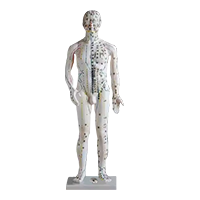
Article tag: 85cm Unisex Torso 40 Parts ADA-208 ADA208
Model | ADA-208 — 85cm Unisex Torso, 40 Parts (dual-gender anatomy torso) |
Summary | 85cm unisex anatomy torso model, 40 removable parts including male genitalia and female genitalia with fetus — dual-gender systems teaching. |
Contents | Torso; female breast plate; head; eyeball; brain (8); spinal nerves (4); lung (4); heart (2); trachea, esophagus and descending aorta; diaphragm; liver; kidney; stomach (2); intestines (4); male genitalia (4); female genitalia with fetus (3) |
Intended Use | Human anatomy and reproductive-system teaching in medical, nursing and health-science classrooms |
Certification | ISO & CE (as stated on the product page) |
Price | Quoted on request — Section 5 names the sibling listing that publishes a price |
Educational-use note: anatomy teaching model — educational equipment, not a medical device. Material and base construction are not stated on the ADA-208 page; request the specification sheet by email.
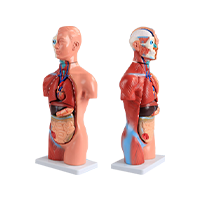
The ADA-208 is an 85 cm dissectible trunk with 40 removable parts: brain in 8 pieces, spinal nerves 4, lung 4, heart 2, stomach 2, intestine 4, male genitalia 4, female genitalia with fetus 3 — plus a female breast plate, head, eyeball, trachea, esophagus, descending aorta, diaphragm, liver and kidney. It carries both sexes on one unit, so a systems block can move from thorax to abdomen to pelvis without swapping models.
The depth sits in the organs, not the surface: eight brain parts and four lung parts invite region-by-region work, and 85 cm is classroom-visible. The trade-off is that this is a systemic trunk, not a sectional or surgical trainer — it teaches relations, not palpation or procedure.
Evidence | Finding |
22 RCTs, 1,435 participants | Pooled effect for 3D-printed physical models 0.77 (95% CI 0.45–1.09, p<0.0001), but with 86% heterogeneity; accuracy measured in only 3 studies (2.81; 92% heterogeneity) |
313 medical students, four modalities | Dissection (n=80) and 3D software (n=72) beat prosection (n=77) and plastic models (n=84); dissection also highest on satisfaction |
44 students, randomised | 3D-model group rated understanding higher (4.86 ± 0.15 vs 4.26 ± 0.22; P=0.0001) and visualisation of pathology higher (4.76 vs 4.26; P=0.0064) |
22 otolaryngology trainees | 3D-printed models met the acceptability threshold at USD 10.74 per session vs USD 2,122.23 for cadaveric training |
200 pelvic MRI reviews; 30 women | Female and preliminary male 3D pelvic prototypes for sex education and clinical practice |
Manipulable 3D vs static images | On a static-image posttest the static group scored higher (p=0.043); no other differences |
Read together, the table supports a narrow claim: a physical dissectible model reliably raises anatomy knowledge, and its main advantage over cadaver work is cost. It does not support a blanket claim that models beat every alternative — two of these studies undercut that.
Plastic is not the best modality in head-to-head work. In the 313-student comparison the plastic-model group was outperformed by both dissection and 3D software on total and multiple-choice questions. Where dissection access exists, the ADA-208 supplements it; it does not obviously replace it.
Manipulation is not the deciding variable. The manipulable-versus-static study found the static-images group scoring higher on one posttest (p=0.043), with no difference elsewhere. Handling the model is not, by itself, the mechanism.
Satisfaction and scores diverge, and no study here tests clinical competence. The 3D-model group felt it understood anatomy better, while the pooled satisfaction and accuracy estimates carry heterogeneity of 86% and 92%.
The clearest number in the literature is per session: USD 10.74 for a 3D-printed model against USD 2,122.23 for cadaveric training — roughly a 200-fold gap, in a study where trainee ratings still met the acceptability threshold.
That comparison used temporal bones, not a torso, so the absolute figures do not transfer — but the structure of the finding does: model-based teaching is priced in tens of dollars per session, cadaver-based teaching in thousands, and the acceptability gate passes without cadaver access. For a school running a full systems-anatomy semester for a large cohort, a reusable 40-part torso is the arithmetic that makes the course possible.
Model | Size | Parts | Best for |
ADA-203 | 26 cm | 15 | Desktop introduction |
ADA-206 | 85 cm | 20 | Sexless core trunk |
ADA-208 | 85 cm | 40 | Dual-gender systems anatomy |
ADA-209 | 55 cm | 20 | Mid-size unisex |
BIX-A1043 | 85 cm | 40 | Same 40-part configuration, with a published price |
Two codes, one configuration. The identical 40-part list is listed both as ADA-208 and as BIX-A1043. The A1043 listing adds what the ADA-208 page omits: PVC construction, a plastic seat, and a published price of US $279.94.
If procurement needs a figure on paper for a tender, quote the code that publishes one; for material, base type or spare parts on either code, ask by email. Do not assume the two listings differ in contents — on the evidence of the pages themselves, they do not.
Station | Time | Activity |
A. System sweep | 20 min | Remove and name organ groups in sequence: thorax → abdomen → pelvis |
B. Brain and lung depth | 15 min | Work the 8-part brain and 4-part lung separately |
C. Dual-gender comparison | 15 min | Compare male and female sets; locate the fetus and describe its position |
D. Blind reassembly | 20 min | Rebuild all 40 parts from a checklist, then explain one relation each |
Assessment checklist
● All 40 parts returned to their correct positions unaided
● Organ relations described spatially, not just named
● Male and female reproductive sets distinguished without prompting
Item | Frequency | Notes |
Surfaces | After each class | Wipe with standard disinfectant; do not soak |
Small parts (brain, genitalia, fetus) | Per use | Handle by the base, never by the pin |
Reassembly | End of lab | All 40 parts seated; model back on its base |
Annual audit | Yearly | Check for missing or cracked parts; order replacements |
A model that is cheap per session is only cheap if the parts survive — this table is part of the cost case.
Q1: Is the ADA-208 life-size? A: It stands 85 cm — a classroom presentation size with anatomically proportioned organs, not full adult height.
Q2: Does it really include both male and female genitalia? A: Yes. The 40-part set includes male genitalia (4 parts) and female genitalia with fetus (3 parts), plus a female breast plate.
Q3: How does it differ from the ADA-206 (85 cm, 20 parts)? A: The ADA-206 is a sexless 20-part trunk. The ADA-208 adds both reproductive sets, the fetus, the 8-part brain and the 4-part lung — 40 parts in total.
Q4: What is it made of? A: The ADA-208 page states no material. The sibling 85cm/40-part listing (BIX-A1043) states PVC on a plastic seat. Confirm for the code you order: adacpr@adaanatomy.com.
Q5: What is the price and MOQ? A: Price is on request for the ADA-208; the sibling A1043 listing publishes US $279.94. MOQ 1 unit. Email adacpr@adaanatomy.com for the quotation.
Q6: What certifications and shipping terms apply? A: ISO & CE as stated on the page; air freight 7–10 business days, sea freight 30–45 days. Details: adacpr@adaanatomy.com.
3D-Printed Models for Anatomy Education: 22-Trial Meta-Analysis (2022)
Musculoskeletal Anatomy: Comparing Four Teaching Modalities (2021)
Manipulable 3D Models vs Static Images in Osteology (2023)
3D-Printed Models in Plastic Surgery Education (2020)
3D-Printed Temporal Bone vs Cadaveric Bone: Cost Analysis (2026)
3D Pelvic Prototype Models for Anatomy Education (2020)