

09-10-2026
ADA MED SUPPLY LIMITED
Article tag: BIX/CPR280 full body CPR training manikin; CPR manikin with pulse simulation; LCD digital CPR feedba
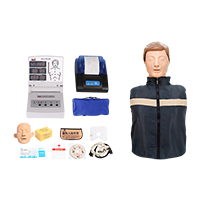
Short answer: The BIX/CPR280 is a full-body adult CPR training manikin priced at USD 441.88. It gives two kinds of feedback at once — a tri-colour light that shows immediately whether each compression and breath is inside the target range, and an LCD counter that tallies correct and incorrect actions — and it adds carotid pulse simulation and pupil response for realism.
Key takeaways
The manikin does not just record a score — it signals in real time. During compressions, a dynamic light shows the depth: green for the 5–6 cm zone, yellow below 5 cm and red above 6 cm, with a digital counter of correct and wrong compressions and an audible prompt explaining the error. The same logic applies to artificial respiration, where the light follows the delivered volume from 500/600 ml up to 1,000 ml. The pupil responds (mydriasis/miosis) and a carotid pulse can be felt, so students also practise the reassessment steps rather than only the mechanics.
| Model | BIX/CPR280 |
| Type | Full-body adult CPR training manikin |
| Feedback | Tri-colour dynamic light + LCD digital counter + sound prompt |
| Compression depth zone | 5–6 cm (green) |
| Ventilation volume | 500/600 ml – 1,000 ml |
| Ratio / rate | 30:2 (one or two rescuers); ~100 compressions per minute |
| Cycle | One cycle = five sets of 30:2 |
| Modes | Exercise / examine / self-defined |
| Vital signs | Carotid pulse simulation; pupil mydriasis and miosis |
| Skin material | Thermoplastic elastomer (face, cervical, chest skin and hair) |
| Certification listed | ISO 13485; CE |
| Reference price | USD 441.88 |
Feedback changes performance, and the effect has been measured. A cluster-randomised controlled trial in 642 laypeople found that training with a real-time visual feedback device produced significantly better chest-compression quality than standard training [1], and comparative work on CPR feedback devices versus standard BLS has reported measurable improvements in depth and rate compliance [2]. This matters because the targets are narrow: the American Heart Association's published adult CPR targets are a compression depth of 5–6 cm, a rate of 100–120 per minute and a 30:2 ratio with one rescuer [3], and learners routinely fall outside them without an indicator to correct against. On the CPR280, that indicator is the tri-colour light, which is why the manikin suits both teaching and assessed practice.
Treat the face, cervical and chest skins as replaceable wear parts and keep the light and LCD units dry. Two points worth confirming before you order: the product page cites the AHA guideline for CPR and ECC (it references the 2005 edition), while the feedback thresholds it implements — 5–6 cm depth, ~100/min, 30:2 — remain the core adult targets in the current guidance [3], so ask the supplier which edition the documentation states; and the page does not publish a package size or gross weight, so request the shipping dimensions if you are budgeting freight.
Q1. What feedback does the BIX/CPR280 give?
A tri-colour dynamic light for compression depth (green 5–6 cm, yellow too shallow, red too deep) and ventilation volume, plus an LCD digital counter of correct and incorrect actions and an audible error prompt.
Q2. Does it simulate a pulse and pupils?
Yes — carotid pulse simulation (including during compressions) and pupil examination with mydriasis and miosis.
Q3. What ratio and rate does it train?
A 30:2 compression-to-ventilation ratio for one or two rescuers, at approximately 100 compressions per minute, with a cycle defined as five sets of 30:2.
Q4. How much does it cost?
The product page lists USD 441.88. Confirm the final price, packing and freight with the supplier for your order quantity.
Q5. Is it suitable for certification-style assessment?
It has an "examine" mode alongside exercise and self-defined modes, with timing and counters — suitable for assessed practice. Confirm any specific certification requirement with your awarding body.
Q6. How do I get a quotation?
Email adacpr@adaanatomy.com with the model (BIX/CPR280), quantity and destination port; our team will send pricing and packing details.
Email adacpr@adaanatomy.com for the BIX/CPR280 price list, spare skins and shipping dimensions. We can also quote the whole CPR series (CPR260, CPR480, CPR490) so you can compare feedback levels in one document.