

23-10-2026
ADA MED SUPPLY LIMITED
Article tag: CPR training manikin with feedback chest compression depth feedback CPR manikin price BLS training e

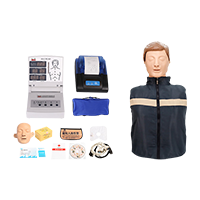
Short answer: BIX/CPR230 is a half-body computer CPR manikin listed at US$382.96. Its feedback is light-and-sound based rather than software-based: compression depth is shown by a dynamic light — green for the 5–6 cm zone, yellow below 5 cm, red above 6 cm — ventilation volume is displayed from 500/600 ml to 1000 ml, and a digital counter records correct and incorrect operations with a voice prompt on error. The page also states a simulated open-airway display and cites the AHA 2005 CPR and ECC guideline.
Key takeaways
| Tier | How feedback works | Typical price position | What you give up |
|---|---|---|---|
| Basic manikin, instructor-scored | Tutor watches and corrects verbally | Lowest | No objective depth or volume record; one tutor can watch one pair of hands |
| Light-indicator manikin (BIX/CPR230) | Depth zones as green/yellow/red; ventilation volume display; error counter | Mid — US$382.96 published | No per-second timeline, no downloadable data, no rate analysis |
| Sensor and software manikin | Continuous depth, rate, recoil and ventilation data logged to a device | Highest | Cost per station, batteries, software maintenance, and a laptop in the room |
| Criterion | BIX/CPR230 published detail | What a sensor manikin adds |
|---|---|---|
| Compression depth | Light zones: green 5–6 cm, yellow <5 cm, red >6 cm | Numerical depth per compression, trend over the session |
| Ventilation volume | Digital indicator, 500/600–1000 ml | Per-breath volume with flow curve |
| Error handling | Digital counter plus audible prompt on wrong operation | Tagged errors with timestamps for debrief |
| Airway | Simulated standard open-airway display | Head tilt and jaw thrust sensing on some models |
| Record | Counter on the unit | Exportable file for certification |
| Price | US$382.96 | Not published here — typically multiples |
Real-time audiovisual feedback during training has been shown to improve CPR performance in a simulation setting, with the gain concentrated in compression depth and rate rather than in ventilation [1]. A 2024 evaluation of feedback-assisted training reached a similar conclusion and added a practical caveat: feedback devices improve the quality of what is measured, so the device has to measure the variables your protocol prioritises [2]. The 2020 international consensus on adult basic life support remains the reference for those variables — depth, rate, recoil and minimal interruptions [3].
The practical consequence for a training centre is arithmetic. At US$382.96, four CPR230 units cost less than one sensor-based station, and four units let sixteen students practise in parallel instead of watching. Where certification requires an exported record per candidate, the sensor tier earns its price; where the record can be a printed or written score, the light-indicator tier is sufficient.
| Check | Why it matters |
|---|---|
| Are face shields or lungs consumable, and at what price? | The recurring cost per student. |
| Does the depth zone match your current guideline? | The page cites AHA 2005; confirm the light thresholds are 5–6 cm as stated. |
| Is the half-body format acceptable for your assessment? | Full-body manikins are required in some curricula for airway and rescue-breathing sequences. |
| Battery or mains? | Determines whether the unit can be taken to a ward. |
| Carton quantity, size and gross weight | Not published; needed for a multi-unit order. |
Email adacpr@adaanatomy.com with your cohort size and ask for the price at four units plus the consumable pack price.
Q1. What is BIX/CPR230?
A half-body computer CPR training manikin with light-zone compression feedback, a ventilation volume display, an error counter and voice prompts.
Q2. How much does it cost?
US$382.96 is listed on the adacpr page. Confirm at your quantity and ask for the consumable pack price.
Q3. What do the coloured lights mean?
Green for 5–6 cm compression depth, yellow below 5 cm, red above 6 cm.
Q4. Can it record a student's performance?
It counts correct and incorrect operations on the unit. It does not export a data file; if you need that, a sensor-based manikin is the alternative.
Q5. Which guideline does it follow?
The page references the AHA 2005 CPR and ECC guideline. Teach current depth and rate recommendations and treat the light zones as a proxy.
Q6. How do I request a quotation?
Email adacpr@adaanatomy.com with model BIX/CPR230, quantity, consumables required and your delivery city.
Write to adacpr@adaanatomy.com for the BIX/CPR230 specification sheet, the consumable list and a landed-cost quotation at your station count. Ask for pricing at four and eight units — that is where the per-student cost falls.