

02-11-2026
ADA MED SUPPLY LIMITED
Article tag: AED training drill BLS training manikin AED98D compression feedback buzzer 10 AED scenarios
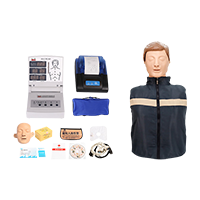
Most AED training fails on logistics, not knowledge: too few stations, a scenario the instructor improvises, and no record of who actually performed a shock sequence. The BIX/AED98D is a half-body BLS trainer built to remove the first two problems — it gives audible cues for compression depth and rate, simulates a carotid pulse, and its defibrillation function follows ten defined AED training scenarios.

| Item | Detail |
|---|---|
| Model | BIX/AED98D |
| Type | Half-body CPR and AED training simulator |
| Compression depth | 5–6 cm; correct-depth buzzer; over-force alarm |
| Compression rate | 100–120 per minute |
| Ventilation | Mouth-to-mouth with chest-rise check; tidal volume reference ≤500 ml / 600–1000 ml |
| Airway | Simulated standard airway opening |
| Circulation | Bulb-squeeze carotid pulse simulation |
| AED mode | Ten AED training scenarios provided |
| Typical buyers | Nursing colleges, hospitals, occupational health centres, higher medical schools |
Three decisions determine whether a 30-minute drill produces competent rescuers.
One trainer per two trainees. AED skills are sequential and hands-on; with four trainees per manikin, two of them spend the scenario watching. Two per unit keeps hands-on time above half the session.
One AED trainer per manikin, not per room. The pause between compression and shock is the skill being taught. Sharing a trainer forces trainees to queue at the critical moment.
Pre-set the scenario. The AED98D ships with ten training scenarios. Choose the scenario before the session and write it on the whiteboard — VF arrest for the first cohort, asystole for the second — so the debrief compares like with like.
0–5 min: safety and recognition. Trainee checks responsiveness, calls for help, opens the airway, checks breathing. Instructor watches for the two-second pulse check, not a thirty-second one.
5–12 min: compressions with the buzzer. The manikin gives a correct-depth tone at 5–6 cm and an alarm if force is excessive. Use the buzzer as a coach, not a judge: trainees should hear the tone and adjust before the instructor speaks.
12–18 min: ventilation. Two breaths with visible chest rise. The listing gives a tidal volume reference of ≤500 ml or 600–1000 ml depending on the mode, which is the number to hold trainees to rather than "blow harder".
18–25 min: AED sequence. Power on, attach pads, clear the patient, analyse, shock if advised, resume compressions immediately. Time the hands-off interval; anything above ten seconds is a fail in most protocols.
25–30 min: debrief and re-run one element. Pick the single weakest element and repeat it twice. Retention at four months is achievable with short, repeated sessions rather than one long lecture [3].
Guideline-based BLS teaching emphasises compression quality because depth and rate are modifiable and measurable [1]. The AED98D's buzzers convert that into instant feedback, which is the mechanism that makes short courses work: a trainee who hears the correct-depth tone for twenty compressions has a physical reference to reproduce later.
The evidence on AED instruction also supports keeping it simple. In a randomised trial of 210 older adults, face-to-face instruction and video-based instruction produced comparable AED performance on a manikin [2] — the format mattered less than the practice. That is an argument for spending your budget on more manikins and more repetitions, not on elaborate production.
| Criterion | Pass standard | Record |
|---|---|---|
| Scene safety and response check | Verbalised within 10 s | Yes/No |
| Compression depth | 5–6 cm, buzzer confirms | Yes/No |
| Compression rate | 100–120/min | Yes/No |
| Full recoil | Visible, no leaning | Yes/No |
| Ventilation | Visible chest rise, volume in range | Yes/No |
| AED pads placement | Correct anterolateral position | Yes/No |
| Hands-off time | ≤10 s from analysis to shock | Seconds |
| Immediate resumption | Compressions within 2 s of shock | Yes/No |
Keep the sheet with the manikin and file it per cohort. When a programme is reviewed, the file — not the certificate — is the evidence.
Q1. What compression depth does the AED98D require?
5–6 cm, with a buzzer when the depth is correct and an alarm if force is excessive.
Q2. Does it teach ventilation volume?
It provides a chest-rise check and a tidal volume reference (≤500 ml or 600–1000 ml by mode), which is what instructors should score against.
Q3. How many AED scenarios are included?
Ten AED training scenarios are specified for the defibrillation function. Request the list to map them to your course.
Q4. Is it a full-body or half-body manikin?
Half-body: a torso-based trainer, which is lighter and cheaper per station and adequate for compressions, ventilation and AED pad placement.
Q5. Can it be used for healthcare staff recertification?
Yes. The scoring sheet above matches the elements most recertification schemes assess; add your local protocol for drug administration if required.
Q6. How do we request a demonstration or quote?
Email adacpr@adaanatomy.com with the number of stations, the AED trainer you use and your delivery city.
For the scenario list, AED compatibility sheet and a station-based quotation: adacpr@adaanatomy.com. Production follows ISO 45001 management practice; CE documentation available for EU procurement.