

03-11-2026
ADA MED SUPPLY LIMITED
Article tag: Heimlich maneuver training vest BIX-H605 pediatric choking first aid trainer abdominal thrust pra
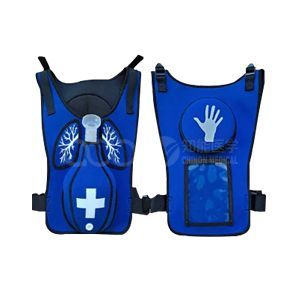
Most choking trainers are torsos on a table, which teaches the hand position but not the height, stance or reach of a real rescuer. The BIX-H605 takes the opposite approach: it is a vest worn by the person playing the casualty, so the trainee practises abdominal thrusts on a standing or seated body at true rescuer height.
| Item | Detail |
|---|---|
| Model | BIX-H605 |
| Category | Emergency models / choking first aid |
| Format | Wearable vest worn by the trainee or a partner |
| Procedure | Abdominal thrusts (Heimlich maneuver) for foreign-body airway obstruction |
| Positions | Standing or seated; can be used against a counter, table or chair |
| Teaching scope | Rescue of another person and self-rescue practice |
| Price | Quoted per order |
| Certification | ISO 9001 / 14001 / 45001 and CE documentation on request |
The Heimlich maneuver is a whole-body skill. Force comes from the rescuer's stance and body weight, not from the arms alone, and the fist must sit above the navel and below the xiphoid process. On a table-mounted torso, trainees learn the hand position but keep their own posture out of the exercise.
A vest forces the missing variables into the drill: the rescuer must step behind a standing casualty, set their feet, and deliver thrusts at their own hip height. The original description of the maneuver is explicit that it is external subdiaphragmatic pressure applied to a standing or seated victim [1], and that is the geometry the vest reproduces.
It also makes self-rescue teachable. A trainee wearing the vest can practise thrusting against the back of a chair or the edge of a counter — the manoeuvre people actually use when alone.
The vest is an abdominal-thrust trainer. It does not replace the infant algorithm, and mixing the two is the most common error in paediatric first aid courses:
Current basic life support guidance treats choking relief as a core lay-rescuer skill with a defined sequence, not an improvised one [2]. Build the drill around the sequence, and use the vest only for the abdominal-thrust step.
The paediatric literature makes the same point from the clinical side. Foreign-body airway obstruction is a common childhood emergency, and reviews of the condition emphasise that outcome depends on how quickly a bystander recognises the obstruction and starts the correct sequence — back blows and chest thrusts for infants, abdominal thrusts for older children and adults [3]. Recognition speed is a training outcome, which is why the station below opens with the silent-cough decision rather than with hand placement.
Because the vest is worn, hygiene is the limiting factor on class size. Plan one vest per two trainees, with disinfectant wipes between wearers and a spare cover per session. A 40-minute station with two vests comfortably rotates 12 trainees.
Q1. Who wears the vest — the rescuer or the casualty?
The casualty. A partner or the instructor wears it so the trainee can practise thrusts on a realistic standing or seated body.
Q2. Can it be used to teach infant choking?
No. Infant relief uses back blows and chest thrusts. Use an infant-specific trainer for that age group.
Q3. Does it measure thrust force?
No. It is a positioning and technique trainer; assessment is by instructor observation.
Q4. Is it reusable across large cohorts?
Yes, with wipe-down between wearers. Plan one vest per two trainees and a spare cover per session for hygiene and throughput.
Q5. What is the price and minimum order?
MOQ is flexible and quoted per order. Email with quantity and destination for the current price list and volume tiers.
Q6. How do we request a sample or a course quotation?
Email adacpr@adaanatomy.com with quantity, city and course type; you will receive the price list, carton data and lead time.
For the specification sheet, vest sizing and a course-size quotation: adacpr@adaanatomy.com. Production follows ISO 45001 management practice; CE documentation is available for EU procurement.