

10-11-2026
ADA MED SUPPLY LIMITED
Article tag: XX-A106 45cm mini skeleton model compact anatomy skeleton classroom skeleton buying guide mini b
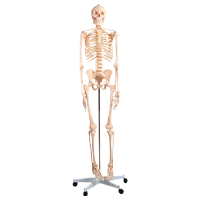
Every anatomy lab eventually owns the wrong skeleton — usually a 180 cm showpiece that nobody can carry between rooms, or a 45 cm model bought for a course that needed life-size proportions. The XX-A106 is the compact option: a 45 cm mini bone model on a stand, sized for a desk, a demonstration bench or a patient-education table. This guide is about choosing it deliberately rather than by price.
| Item | Detail |
|---|---|
| Model | XX-A106 |
| Type | Mini bone model (compact skeleton) |
| Height | 45 cm |
| Mounting | Stand included |
| Best use | Desk study, classroom demonstration, patient education, spotter exams |
| Related sizes on the same catalogue | 42 cm (BIX-A1006), 85 cm (BIX-A1004), 180 cm (BIX-A1002) |
| Price | Quoted per order |
| Certifications | ISO documentation on request |
Desk-scale study is a real method, not a compromise. A model that fits beside a textbook gets used during reading, which is when students actually learn bone names. A full-size skeleton in a cabinet is used twice a term. The pedagogical value of physical models comes from repeated, low-friction contact [1], and friction is mostly a function of size and weight.
Demonstration without a projector. A 45 cm model can be held up in one hand while the other hand points. In a small tutorial room that is often better than a slide, because the class can see the relationship between the sternum, the ribs and the spine from an angle.
Patient education. Explaining a fracture or a spinal level to a patient works better with something that can be turned on a table. A 45 cm model is non-threatening, clean and easy to store in a consulting room.
| Teaching situation | Practical ratio | Why |
|---|---|---|
| Lecture demonstration | 1 per room | Visible from the front rows only |
| Small-group tutorial (8–12) | 1 per 4 students | Students must handle it to learn landmarks |
| Self-study library | 1 per 20 students on loan | Availability drives use more than quality |
| Spotter exam | 1 per station | One station per model; label pins separately |
| Patient education | 1 per consulting room | Rests on a desk, no storage problem |
The budget mistake to avoid: buying ten mini skeletons when one 85 cm and six 45 cm models would serve both demonstration and study. Mix sizes by function, not by count.
Documentation and quotation. Packing data, certificates and current pricing for the XX-A106 are available in writing from adacpr@adaanatomy.com before you place the order.
Q1. Is the XX-A106 life-size? No. It is a 45 cm mini bone model. For life-size proportions use a 170–180 cm skeleton; the 85 cm model is the usual compromise for classrooms.
Q2. Does it come with a stand? Yes. The model is supplied on a stand for desk or bench display. Confirm base dimensions if shelf space is limited.
Q3. Can students take it apart? The model is a study skeleton, not a disarticulated set. If your course needs individual bones, order a disarticulated skeleton instead.
Q4. Is it suitable for medical students? For early anatomy and terminology, yes. For osteology practicals and measurements, a full-size model is required.
Q5. What is the minimum order? Quoted per order and dependent on destination. Ask for carton quantity so that freight is calculated correctly.
Q6. How is it packed? Packing details are quoted with the order. Request the carton size and gross weight before choosing air freight.
For a quotation on the XX-A106, mixed-size class sets and carton data, write to adacpr@adaanatomy.com with your student numbers and the rooms the models will live in.