

13-11-2026
ADA MED SUPPLY LIMITED
Article tag: BIX-J3A infant intubation training head infant airway anatomy oral and nasal intubation lung inf
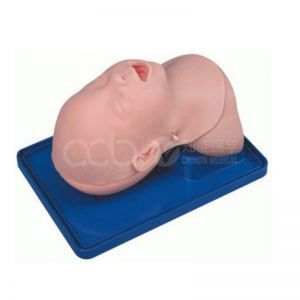
Infant intubation sits between two harder skills. It is not the neonate airway, where the tissue is fragile and the margin for error is measured in seconds, and it is not the child airway, where landmarks have begun to look adult. The infant is the intermediate case, and intermediate cases are where trainees most often transfer a technique that does not fit.
The BIX-J3A is an infant intubation training head with realistic mouth, pharynx and trachea anatomy. It supports oral and nasal intubation, allows the head and neck to flex forward for positioning, and lets the trainee observe lung and stomach inflation to verify tube position. This article covers how to use those features, and what the model still cannot tell the trainee.
| Feature | Detail | Training use |
|---|---|---|
| Anatomy | Realistic infant mouth, pharynx and trachea | Landmark recognition and tube path |
| Routes | Oral and nasal intubation | Practising both approaches as separate skills |
| Positioning | Head and neck flex forward | Demonstrates how position changes the view |
| Confirmation | Lungs and stomach inflate visibly when air is insufflated | Distinguishes tracheal from oesophageal placement |
| Reference price | USD 117.84 | Budget planning for a skills lab |
The inflation feature is the most useful part of the design. A trainee who watches the stomach inflate while the lungs stay flat has seen oesophageal intubation with their own eyes — a lesson that a verbal warning does not deliver. In clinical practice, confirmation relies on clinical signs and, where available, capnography; the model makes the principle visible before the trainee meets it in a patient [1].
Oral intubation is faster and is the default in most infant resuscitation pathways. Nasal intubation is a planned choice, used when the oral route is unsuitable or a longer-term secure tube is needed. The two routes use different tube paths and different failure modes.
Run them as separate stations:
The third station is where judgement is trained. The first two train hands.
A trainee who leaves the lab believing that visible lung inflation equals a secured airway has learned a dangerous shortcut. The debrief must state the clinical confirmation standard explicitly.
Quotation and specification. Current pricing, spare parts and delivery for the BIX-J3A are available from adacpr@adaanatomy.com.
Q1. What does the BIX-J3A represent? An infant airway, with realistic mouth, pharynx and trachea anatomy, for oral and nasal intubation practice.
Q2. Can the head be positioned? Yes, the head and neck can flex forward so the trainee can practise positioning as part of the procedure.
Q3. How is tube position verified on the model? By insufflating air and watching whether the lungs or the stomach inflate — the model makes correct and incorrect placement visible.
Q4. Is it suitable for neonatal training? It represents an infant, not a newborn; neonatal courses should use a dedicated neonate model.
Q5. What is the reference price? USD 117.84, subject to order quantity and configuration.
Q6. What consumables are required? Infant tubes, a suitable laryngoscope blade, suction catheters and lubricant; confirm the recommended tube range with the supplier.
Product page: Infant Intubation on the BIX-J3A: What the Head Can and Cannot Confirm — specification, packing data and a quotation request form.
For a quotation on the BIX-J3A, or to confirm the tube sizes the head accepts, write to adacpr@adaanatomy.com with your course and trainee numbers.